Showing posts with label regenerative agriculture. Show all posts

Monday, December 7, 2020

Has Regenerative Agriculture's time arrived?

 In The Social dilemma, a documentary featured on Netflix, a group of young tech-savvy veterans of the social media world lay out their concerns about the undesirable influences exerted by social media giants on individual lives and on society writ large.  It’s a long and complicated story, but it comes down to this: These companies: Google, Facebook, Twitter, Instagram, Pinterest, and others, consider your web presence, if you have one, almost entirely in terms of its capacity to draw “eyeballs”. They don’t make it their business to care about content per se. Ultimately, they’re selling ad space based on viewership.

A thought that occurred to me in the midst of my morose ruminations about social media: they might just be useful in telling us indirectly about the salience of a particular topic or person in society.  It goes without saying, of course, that having a high level of visibility on social media is not a figure of merit except in some narrow sense.  With that rather ill-formed thought in mind, I googled “regenerative agriculture”.  It took less than a second for Google to come up with 19,800,000 results.  Wow, I thought, that’s an impressive number!  Then I searched for links to Lady Gaga, whose music I often like, and came up with 210,000,000 results. Actually, the comparative results made me feel pretty good.  As a serious, non-entertainment topic, regenerative ag is doing pretty well. I feel a measure of confidence that regenerative agriculture is becoming a thing in the social universe. So what is it?


In the 1980s the Rodale Institute began using the term ‘regenerative agriculture’ in their publications and formed the Regenerative Agriculture Association. No one can give a definition that will leave everyone happy, but this one, borrowed from Wikipedia, should serve:

Regenerative agriculture is a system of farming principles and practices that seeks to rehabilitate and enhance the entire ecosystem of the farm by placing a heavy premium on soil health with attention also paid to water management, fertilizer use, and more.


The consequences of a century of reliance on industrial methods of farming have been devastating to the soils of America’s great plains.
It all began when the U.S. passed the Homestead Acts of 1862 to encourage agricultural development of the Great Plains. A settler could claim ownership of up to 160 acres of land, provided that he lived on it for a period of five years and cultivated it. People had no idea how to farm the virgin plains as they became settled. As tractors and farm machinery became available, they did all the wrong things -- careless of maintaining the soil, deep-plowing the grasslands with abandon.  In the 1930s, droughts in the plains set up the conditions for the Dust Bowl, dust storms that proved to be the greatest single ecological disaster the nation has known. Unfortunately, the lessons of the Dust Bowl were not well learned.  A recent report of the Intergovernmental Panel on Climate Change focusing on land details how the forced conversion of natural landscapes in the interests of increasing crop yields has worked havoc across the globe. 


 We don’t have many years left to halt soil degradation and to restore desertified land, to restore natural landscapes. The way back to restored, productive soil is at the same time a pathway toward lowering the concentrations of atmospheric greenhouse gases, especially carbon dioxide. Regenerative agricultural practices involve no-till management of the soil, discontinuance of pesticides, herbicides and industrially produced fertilizers. Soils are kept with something planted year-round. Cover crops include legumes such as vetch, clover, radishes and peas, and annual grains such as winter rye. These cover crops are managed so that they protect the soil from erosion and build a soil rich with root systems that soak up carbon dioxide from the atmosphere. Regenerative agriculture is in effect, a restoration project, an obeisance to nature. Cash crops, such as corn or soybeans, are sown into soil that maintains its cover crops. You can learn about all this by watching the beautiful and inspiring film, Kiss the Ground. You’ll learn about regenerative agriculture from people like Gabe Brown, in my book a star right up there with Lady Gaga.


You can’t but wonder after watching Kiss the Ground why there hasn’t been a massive shift to regenerative ag practices.  One clue is that Gabe makes a point of not accepting money from the government. That might seem surprising, given that federal subsidies for agriculture are plentiful; on the order of $30 BILLION dollars annually.  A big fraction of that money goes into the pockets of large-scale farming operations and into the coffers of the big ag companies. All of that fertilizer, pesticides, and herbicides, genetically modified seed varieties, and cash price support money, just for starters, has produced an enormous lobby invested in keeping the party going.  In 2019 the government spent $22 BILLION on farm aid related to the trade wars.  Farmers were getting checks that seemed to come out of the blue.


Remember all the fierce debates in Congress and in the public back in 2008 when the government bailed out the auto industry? I’m mystified why we don’t hear loud objections to the much larger recent subsidies to agriculture, much paid out by the USDA without the agency even going through Congress.  Agriculture seems to be built on one subsidy after another.  Many large landowners, already rich off federal money, wondered why they were getting unexpected checks.  Those billions might have been spent on other urgent social programs, instead of mollifying the farm block over potential losses resulting from President Trump’s trade wars. What a wasted opportunity!  What farmers do with their land has a huge impact on water quality, wildlife, and climate change. The USDA could have mounted effective programs that pay farmers to improve the environment, restoration of wetlands, and switching to regenerative methods of farming.


The saying goes that the present is but the child of the past. Let’s take a step back and ask why so much corn is grown across America’s heartland. An article written by Jonathan Foley in 2013 is still relevant today.  Foley points out that only a tiny fraction of the national corn crop is directly used for food for Americans, mainly for high-fructose corn syrup.  A big portion is fed to animals, which we then slaughter and eat.  The fraction of available food calories in feed corn that ends up in the meat and dairy we humans eat is really small. Perhaps the largest single market for corn is a conversion into ethanol. The notion of all the plowing, planting, discing, fertilizing, irrigating, harvesting, storing, and transporting, then converting the corn into alcohol in an energy-intensive, inefficient process, only to burn it in a car engine, never did make sense. It’s now just a way to dispose of the huge excesses of corn produced by farmers who want to get in on free money the government is handing out. It’s no surprise then that in 2019 total corn production in the U.S. increased by 17.5%.   By the way, the folks converting the corn that no one can use into ethanol that can’t rationally be justified as a fuel also receive subsidies for that work since it makes no sense economically. 


What will it take to really change things? Maybe, just maybe, newly elected President Biden will do the right thing and appoint Representative Marcia Fudge as Secretary of Agriculture. She’s shown that she’s ready and able to turn USDA into an effective and socially conscious tool for reform of American agriculture.


Let’s return briefly to Google search. Near the top of the list of the 19.8 million results of the search for “regenerative agriculture” are organizations of all sorts involved in one way or another with agriculture.  Bayer, a corporation at the top of the list, manufactures weedkillers, pesticides and the like. Another, the French company Danone, sells prebiotic yogurts such as Activa, and dairy-free drinks such as soy milk. They must have found their way onto the list via some sort of google algorithm magic.  Neither company has much investment in regenerative ag, though Danone has a few stories to tell. They hardly offset its sorry record as one of the top ten producers globally of packaged water, a global blight in its own right.  I’m left wondering about how profit works its way into decisions about how things pop up in searches. 


The fact that many corporations are feeling their way into regenerative practices, if only by loose association, in an effort to look good could be taken as a sign of progress, I suppose. But those serious about the promise of regenerative agriculture as a suite of disruptive technologies, with the power to improve agriculture’s environmental impact and make a significant contribution to lowering the rate of increase of greenhouse gases, know that the journey is just beginning, and the road ahead will be rough. 

But we needn’t focus only on big ag in our search for promising change. In my next blog, I’ll write about regenerative ag at local levels. That will be more fun and it’s actually quite important.




Tuesday, August 20, 2019

More on secular shifts and episodic events

In my most recent blog, I made an effort to distinguish between two categories of things which should form the basis of our discussions regarding climate change. These are:
  • Episodic Events
  • Secular Shifts
Episodic events are of short duration-they come and go:  tornadoes, extreme heatwaves, hurricanes of exceptional power, floods.  They grab our attention right now.
Secular shifts, on the other hand, are of long duration, consistently moving in a single direction: sea-level rise, the concentrations of greenhouse gases in the atmosphere, global population increase.
The major message of my blog was that, although we become preoccupied with episodic events and fret over them, it is the secular shifts that threaten disaster for humanity.
It follows from this that when we look at the daily stream of articles and opinions regarding climate change and the environment, we should try to ascertain the extent to which the topic of the discussion is important for one or more secular shifts.  Here are a few examples drawn from the recent flow of environmental and climate news.

  • The White House recently announced that it is considering the relaxation or elimination of existing EPA regulations regarding methane emissions from natural gas facilities. Why is this important?  Methane is often found as a chief component of natural gas; it’s a fossil fuel in its own right. When it is consumed as a fuel, carbon dioxide, the major greenhouse gas, is produced.  But when methane sneaks out of oil wells, escapes from pipelines or is vented as a nuisance, and becomes a component of the atmosphere,  it’s a much more powerful greenhouse gas than carbon dioxide. Methane emissions have increased markedly in recent decades; methane is now responsible for about a quarter of the planet’s warming. Relaxation of the regulations on methane emissions could result in substantial increases in the rate at which the planet warms, the single most important secular shift we face. 

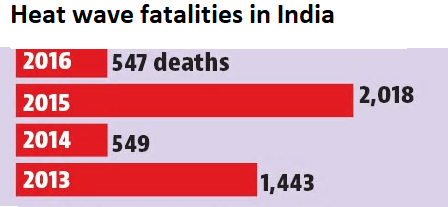
  • We humans are able to live day-to-day, individually or as communities, only within a rather narrow range of temperature.  This fact becomes more salient as the planet warms and weather patterns shift. A large percentage of the earth’s people live in tropical or temperate climate zones.  India has a population in excess of 1.3 billion and contains nearly a fifth of the world’s population.   It has seen six major droughts and drought-like situations in 10 of the last 17 years, devastating India’s farm economy.  The driving force for this unfortunate shift has been lower south-west monsoon rainfall.  Latest studies by the Indian Institute of Tropical Meteorology (IITM) show that average rainfall during the monsoon period is falling as the Indian Ocean gets warmer. For example, Chennai, a southeast Indian city of 10 million, receives most of its rainfall during the annual two-month autumn monsoon season. In recent decades, however, droughts have become more intense.  At the same time, temperatures have risen substantially during the hot months of the year. Air conditioning is a luxury; most people just have to sweat it out during the hottest periods. Water is so scarce in working-class neighborhoods of the city that the government has been forced to spend huge amounts of money to desalinate seawater, bring the water by train from hundreds of miles away, and distribute it from an army of water trucks into neighborhoods where household taps have been dry for months.  This is a city of 10 million people!  At the same time, the Indian government has documented hundreds of deaths due to extreme heat.

To add insult to injury,  despite the lower total rainfall there have been episodes of extreme downpour.

We in the US make up about 5% of the world’s population. Understandably, we tend to form judgments about global conditions from what we experience in our own country.  But what happens in India is more representative of the challenges facing most of humanity.  The more extreme climatic conditions seen in semi-tropical regions are in many cases portents of what is to come in our country.  All these episodic weather events are the products of secular changes in the planet’s climate, driven by increases in atmospheric greenhouse gases. 


  • What about the heat in the U. S.?  The Union of Concerned Scientists recently issued a report on the increasing number of extreme heat events all over the world, and particularly in the United States. Their projections, based on analysis of data covering decades and modeling of expected future weather patterns, shows that the U.S.faces a potentially staggering expansion of dangerous heat over the coming decades.  Dallas, TX , for example, has experienced 31 above 1000 degree days during 1971-2000.  It’s projected to experience 93 such days during 2036-2065 and 124 days during 2066-2099. The trend line suggests that in 2020 Dallas can expect to have perhaps 40 or so days of extreme heat, with all that implies for heat-related illnesses and fatalities, to say nothing of the huge demands for energy to operate air conditioning machinery. The body’s ability to survive at a temperature of 1000 depends on humidity and the availability of water to maintain hydration, but for the elderly and people in poor health, that level of heat is life-threatening.  The air conditioning and refrigeration needed to counter the heat waves consumes exceptionally large quantities of energy.  Episodic extreme heat events worldwide can be expected to increase in number and intensity as the planet continues to warm,  producing a vicious cycle of added energy consumption, thus amplifying the secular shift of global warming.   

  • Tropical forests globally are being lost at a rate of more than 60,000 square miles per year.  A global initiative to restore large swaths of forest,  termed the Bonn Challenge, was launched in 2011.  Countries were to make commitments to restore large areas of the world’s deforested and degraded land by 2020. Since then the goal regarding the area to be restored has been increased to about 1.3 million square miles by 2030.  That’s a lot of land, about twice the area of Alaska. Ideally, reforestation is a great pathway to mitigating the continued increases in carbon dioxide in the atmosphere. Forests are capable of soaking up carbon dioxide from the atmosphere. They can improve farmers’ lives in many parts of the world, improve drinking water quality, and provide increased habitat protection for wildlife.  So if the Bonn Challenge could be met, it would represent a significant effort to mitigate the secular change in greenhouse gas warming. 
    But as explained in a recent article in the journal Science, “many short term fixes fail to produce environmentally and socially beneficial long-term outcomes”. One of the most common missteps is to favor single-species tree plantations over restoring native forest ecosystems. This obviously has negative consequences for biodiversity and carbon storage, and typically works to the disadvantage of native populations.  Some nations have indeed planted a lot of trees on abandoned poor quality land or land not suited for food production, but much of the restoration involves using trees that are intended for harvesting at some point.  To maximize the benefits of restoration, trees must be left in place for longer times, encouraging diversity in the ground cover and promoting wildlife habitation.  Tearing up the Amazon rainforest to plant coffee trees or create a palm oil plantation is a step backward.  Done right, restored forests could sequester a significant amount of carbon dioxide and help limit global warming and enhance the lives of millions of people. On the other hand, a potentially great secular initiative could slip into being a disappointing episodic event. 

  • I have long been an avid follower of efforts to revolutionize agricultural practices globally.  It’s such an obvious place to begin making a serious dent in the rate at which greenhouse gases are being added to the atmosphere.  And this, after all, is the single most important factor in determining how disastrously our anthropocentric imprints on climate change turn out. Agriculture is the world’s largest industry. About a billion people are engaged in farming.  About half the world’s habitable land is pasture and cropland.  Agriculture is essential, and potentially the single most powerful force for improving the lot of humankind generally.  It’s also one of the worst polluting industries on the planet. Of course, there isn’t just one “agriculture”.  This so-called industry varies from pitiable scratching in unproductive ground to behemoths of midwest farmland, costing as much as $400,000 and more--and that’s just for the tractor!  

The huge diversity in agriculture, based on economic factors, the conditions of the land and a host of other climate-related factors, precludes any single approach to raising agriculture’s contributions confronting climate change. It is quite evident, however, that there is room for massive reforms in conventional farming in the US and many other developed nations. Those reforms come under the general heading of regenerative farming practice.  The conventional practices that have become dominant emphasize monocultures, plowing practices that result in topsoil erosion, and heavy use of pesticides and herbicides.  The big ag corporations love it, they’ve grown rich by making the farmers dependent on them.  But there are winds of change a blowin’.  Here’s one example:
One of the precepts of regenerative agriculture is to leave the land as undisturbed as possible.  No-till practices leave the soil able to develop deep root systems with cover crops, which form deep root systems and promote sequestration of water and carbon dioxide. Their roots produce nodules that fix nitrogen which feeds the crops, and holds the soil in place in heavy rainfall, reducing runoff. To read a nice story on how this is playing out in midwest farm country, check this link.   Cover crop acreage is still small, but it’s increasing rapidly. According to a U.S. Department of Agriculture census, cover crop acreage increased 50% nationally during 2012-2017.

As the prospect of global warming looms ever larger, more attention is being paid to how we can offset our current dependence on fossil fuels by switching to renewable energy sources.  There is great enthusiasm for many promising modalities, especially solar and wind, and including also technologies for energy storage which will be essential to sustaining a balanced system with massive capacity.  But I’m not beamish about many of the rosy scenarios being drawn.  California recently set a goal of carbon-free electricity by 2045. This is an ambitious goal.  It ‘s sobering to realize that, ambitious as it is, it does not address the transportation sector, which produces two-thirds of the state’s emissions.  I recently came across this quote on the web:

“Humanity is owed a serious investigation of how we have gone so far with the decarbonization project without a serious challenge in terms of engineering reality.”  
– Michael Kelly, Prof. Electrical Engineering, Cambridge 

The issue of how to get to a carbon-free economy, especially one that might not include nuclear energy, has not been satisfactorily addressed by people who should know how far we are from that goal.  It’s true that, to the extent they can be deployed, renewable energy sources are capable of mitigating the continued increases in greenhouse gases.  But their capacity to do that is actually less than what is achievable by implementing many of the solutions described in
Project Drawdown, a roadmap with which everyone should be familiar. 


Saturday, May 11, 2019

Where is agriculture headed?


You’d have to be really out of touch not to have heard of the microbiome, the community of microorganisms that share our body space.  The microbiome is composed of a very large number of microbial species, the vast majority of which live in our digestive systems.  In recent times we’ve come to appreciate the importance of these little fellows to our well-being. We’ve learned to pay attention to them, to feed them good stuff, such as prebiotics and yogurts. We’ve come to understand that the relationship of diet to wellness lies in the interaction of the microbiome with everything we consume.
It occurred to me recently that the human-microbiome relationship is similar to that between plants and the soil in which they grow.  The quality of soil from the standpoint of its capacity to sustain plant life very much depends on what’s in it.  Healthy soil isn’t just dirt—it contains a complex system of interconnected soil organisms that are essential to the capacity of soil to function as a home for plants, just as our intestinal microbiome is essential to our capacity to ingest food in maintaining whole body health. Soil organisms assist with the digestion of needed nutrients for a plant, keep nutrients in place, provide structural support and water management, and many other functions.

Industrial agriculture has been premised on the notion that we humans can sustainably provide just about everything a crop plant needs. In their model, it’s not necessary to preserve an abundant, deeply rooted community of diverse organisms that support the growing of food crops.  Industrial agriculture works on the assumption that it’s OK to continually plow up the soil, virtually stripping it of life other than the annual plantings.  Thus, the soil of industrially farmed land lacks organisms that exude sticky carbon substances that hold soil particles together, imparting to healthy soil a crumbly texture.  The structure of healthy soil has pore sizes that allow it to drain when it’s wet, and store water that would otherwise run off in heavy rains. The pores also bring air to the roots. Healthy soil is a complex ecosystem, an interconnected web of organisms and their physical environment.  

By contrast, industrial agriculture has made the soil into a lifeless structure that merely holds the plants. Big agribusiness supplies all the heavy machinery needed to plow and weed the fields, and of course, major nutrients for the plants, pesticides, herbicides and genetically modified seeds, designed to compensate for the lack of a diverse and richly varied soil, with its abundant population of insects, fungi and the like that serve to protect plants.
Most farming operations in the US today buy into the framework supplied by industrial agriculture. There is a never-ending succession of fixes to invasions of insects, infestations of infections, massive runoffs and crop losses from flooding in heavy rains, and losses in dry spells because the soil has no capacity to retain water. The so-called green revolution has succeeded only by virtue of robbing the land of riches that must be preserved if agriculture is to be sustainable. 

Back in the 1960s, Kansas farmers found that a huge aquifer lay beneath the land they were farming. The Ogallala, located beneath the Great Plains in the United States, is, or was, one of the world’s largest aquifers.  It underlies an area of approximately 174,000 sq mi in portions of eight states: South Dakota, Nebraska, Wyoming, Colorado, Kansas, Oklahoma, New Mexico and Texas. Anyone who has flown over the plains states in years past is familiar with the sight of center-pivot irrigators — the rigs that created circles of lush cropland by pumping water from the Ogallala onto the fields. Today, in many parts of the Great Plains those rigs are no longer running. They remain as mute reminders that plundering the world’s natural resources for short-term gain is ultimately a loser’s game. In many parts of the Ogallala aquifer, the water levels have fallen so far that it is no longer feasible to pump from it.  The irony is that all that water would not have been needed if the land been farmed regeneratively.

Meanwhile, in March of this year, the state of Nebraska was in a state of emergency due to heavy rainfall. A massive so-called "bomb cyclone" battered the central United States with heavy snow, howling winds and several tornadoes. Flooding forced evacuations in adjoining states as well. Conventional industrial agriculture leaves fields prone to massive runoffs following heavy rainstorms, with the result that stormwater washes fertilizer, herbicides, pesticides, and animal waste off the farmland (and, incidentally, off lawns and golf courses). Aside from the ruinous loss of crops, runoff carries pollutants into lakes and rivers used for drinking water supplies. When the runoff ends up in reservoirs, it promotes algal blooms which can become toxic. 
But it doesn’t need to be the way the agribusiness giants would have it.  We know that the plants and soils of a natural prairie absorb much, if not all, of the rain during a thunderstorm. Why can’t agricultural practices build on what we know works in nature?  It may seem counter-intuitive to look to pre-industrial practices, but it’s nothing of the kind, as has been demonstrated all over the world. I’ll mention here just a few examples. They all fit under the general heading of regenerative agriculture.

I recently read a fine book, Call of the Reed Warbler, by Charles Massy.  The author is Australian, with a long career in dealing with the tough challenges that Australia presents for conventional agriculture.  When Europeans came to settle, they brought with them strong opinions on how to farm successfully.   But most of Australia presented conditions they didn’t know how to deal with, particularly in the low amounts of rainfall, as well as its erratic nature, and soil types that they failed to understand.  Many attempts to farm ended in failures and abandonment of the land. But a few pioneers went against the conventional wisdom regarding water management. They found ways to conserve water and protect the soil with cover crops, proper rotations of grazing pastures and other methods.

Massy also refers to the work of pioneers in other places, especially Africa, where desertification has left so much land unproductive.  Allan Savory is one of the great pioneers in regenerative agriculture.  A native of Zimbabwe, he has concentrated his efforts in the restoration of land that has been desertified over time through human activities. His aim is to convert such lands to productive grassland through managing the land in concert with the grazing of livestock. His work is controversial in some circles, in part, I think because many would like to see less use of animals in human diets.  But for many of the people of Africa whose livelihood and diet have for generations depended on grazing animals, Savory’s methods, referred to as holistic management, have resulted in greening of huge tracts of formerly unproductive land.  Holistic management is far less of a threat to global warming than the industrial model of producing meat. The lush grasslands soak up CO2, thus helping to draw down the levels of the most important contributor to global warming. I recommend that you watch Savory’s TED presentation.  As TED's founder, Chris Anderson commented, it’s astonishing.

I’m a vegetarian, and I’ve long believed that an important step we could take to ward off global warming would be to shift the human diet from animal-based to plant-based.  I'm convinced that a plant-based diet is superior from a health perspective, but Savory has shown that warding off global warming does not require that we entirely abandon eating meats.  We must, however, cease industrial meat production, which comes at a high cost to our health and the quality of the environment. As recounted in The Guardian in 2017, in America food animal production has caused massive pollution of water.  Vast areas in the Gulf of Mexico, have turned into dead zones because of pollution flowing into the Mississippi River and thence into the gulf.  Industrial pig farming is a particularly egregious form of CAFO (concentrated animal feeding operation).  CAFOs store swine waste in giant vats referred to as lagoons, which often contain pathogens—salmonella, antibiotics and antimicrobials that have been fed to the animals—as well as nutrient pollutants such as nitrogen and phosphorus. If the water from these lagoons leaches out into the soil and trickles down into the water table beneath, the surrounding communities suffer. Conditions have grown worse as climate change has brought on powerful storms that cause flooding of lagoons, and hurricanes that can wipe out the lagoons. There is really no satisfactory solution to the environmental deterioration caused by these industrial-scale operations that the corporations would be willing to invest in. Smithfield Foods, a huge corporation that operates pig farms in North Carolina has been cited numerous times for creating living conditions unbearable for anyone living anywhere near one of their operations.  The injurious effects on affected communities are a form of environmental injustice—most of the people affected have no relationship with the corporations.  But “big ag” is very big business indeed; it has tremendous pull with state and federal legislators. The Center for American Progress recently floated a novel idea to counter the effects of a rapidly consolidating agriculture industry: an independent task force at USDA charged with maintaining competitive markets and protecting farmers from the harms of consolidation. In a related vein, a bill from Sen. Cory Booker and Rep. Mark Pocan would temporarily ban future ag mergers while Congress rewrites antitrust laws to strengthen enforcement against anti-competitive deals.

Farmer Gabe Brown provides another example of how regenerative agriculture can rewrite the rules for ecologically and economically successful farming. Brown and his family have employed regenerative agricultural practices on several thousand acres in North Dakota to produce healthy and highly productive soil without the need for fertilization, pesticides or herbicides. Their soil soaks up tremendous amounts of CO2, holds it long-term, and absorbs large quantities of rainfall without runoff. To learn more about how Gabe does it, and the background science, check out this video. Gabe is a really entertaining guy!  I was impressed with the sense of wholeness in the efforts around the globe to restore soils to their legacy conditions.  Gabe rotates animals on his holdings in a similar way to Allen Savory.  Half a world apart and with vastly different cultural underpinnings these two and many others are treading on common ground—healthy soil.
After learning about the work of these pioneers, I’m left feeling that I need to investigate further.  I don’t see how the use of grazing animals on farmland can, or even should be, scaled to the production of food across large areas such as America’s plains states. It seems clear that benefits accrue from the grazing.  There should be ways to simulate the beneficial effects of grazing animals on large tracts of croplands. In any case, it's certainly past time for industrial agriculture to adopt new practices if we’re to save the planet from environmental degradation and global warming while providing food for a rising global population.